Test4.javaDownload: java1.zip.
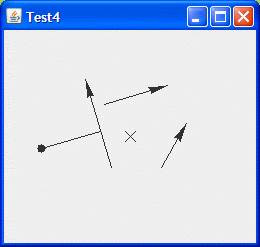
The program Test4 tests the operation of the Line2 and
Arrow classes.
Line2 is constructed from two points
(class Vec2) and captures some
of the geometric properties and constructions of line segments.
Arrow extends Line2 and provides the capability
of displaying a Line2 object as an arrow. The class was designed
so that an arrow could be constructed directly and displayed through a member
data function or use a Line2 object as an argument to a static
member function to display an arrow.
// Test2.java
import java.awt.Graphics;
import javax.swing.JPanel;
import javax.swing.JFrame;


class Panel4 extends JPanel
{

    Line2 line[];
    Vec2 pts[];
    Line2 perp_line;

    public Panel4()
    {
	line = new Line2[3];
	line[0] = new Line2(-0.3,-0.5,-0.7,0.9);
	line[1] = new Line2();
	line[1].from(0.5,-0.5).away(0.8,60.0);
	Vec2 a = new Vec2(-0.4,0.5);
	Vec2 b = new Vec2(0.6, 0.8);
	line[2] = new Line2(a,b);
	pts = new Vec2[1];
	pts[0] = new Vec2(-1.4,-0.2);
	double s = line[0].getClosestPosition(pts[0]);
	perp_line = new Line2(pts[0], line[0].lerp(s));
    }
    public void paintComponent(Graphics g)
    {
	super.paintComponent( g );
	// world/screen transformation
	Vec2.xoffset = getWidth()/2;
	Vec2.yoffset = getHeight()/2;
	int resx = getWidth()/4;
	int resy = getHeight()/3;
	Vec2.Resolution = (resx<resy? resx: resy);
	// Here are our objects
	//for (int i=0; i<line.length; i++) line[i].draw(g);
	for (int i=0; i<line.length; i++)
	    Arrow.draw(line[i],g,1.0,Arrow.AH_FILLED);
	for (int j=0; j<pts.length; j++) pts[j].draw(g);
	perp_line.draw(g);
	// Coordinate origin
	Vec2 origin = new Vec2(0,0);
	int [] iv = origin.convert();
	int size = 5;
	g.drawLine(iv[0]-size,iv[1]-size,iv[0]+size,iv[1]+size);
	g.drawLine(iv[0]-size,iv[1]+size,iv[0]+size,iv[1]-size);
    }
}

public class Test4
{

    public static void test1()
    {
	Vec2 a = new Vec2(14,20);
	Vec2 b = new Vec2(4,-3);
	Vec2 c = new Vec2(6,8);
	Vec2 d = new Vec2(-8,4);

	Line2 AB = new Line2(a,b);
	Line2 CD = new Line2(c,d);


	System.out.println( "line AB: " + AB );
	System.out.println( "line CD: " + CD );
	System.out.println( "line AB + Vec2(1,-1): " + AB.translate(1.0,-1.0) );

	System.out.println( "length AB : " + AB.length() );
	System.out.println( "angle(AB,CD) : " + Line2.angle(AB,CD) );

	Line2 XY = new Line2();
	System.out.println( "XY.from(0,1).to(3,2): " + XY.from(0,1).to(3,2) );
	System.out.println( "XY.to(a).from(b): " + XY.to(a).from(b) );

	Vec2 angled = new Vec2(30.0);
	System.out.println( "angled = Vec2(30.0): " + angled );
	System.out.println( "Line2(1,2,3,4): " + new Line2(1,2,3,4) );
	Line2 R1 = new Line2(angled);
	System.out.println( "R1 = Line2(30.0)): " + R1 );

	Line2 R2 = new Line2();
	R2.from(1,1).away(1.0,-90.0);
	System.out.println( "R2.from(1,1).away(1.0,-90.0) " + R2 );
	System.out.println("test 1 done.");

    }

    public static void main(String args[] )
    {
	Panel4 panel = new Panel4();
	for (int i=0; i<args.length; i++) {
	    String str = String.format("arg[%d] %s",i,args[i]);
	    System.out.println(str);
	}
	if (args.length>0 && args[0].equals("1"))
	{
	    test1();
	    return;
	}
	JFrame application = new JFrame("Test4");
	application.setDefaultCloseOperation(JFrame.EXIT_ON_CLOSE);
	application.add(panel);
	application.setSize(200,200);
	application.setVisible(true);
    }
}
When run with the first command argument of "1", the
program generates some validation tasks to test various aspects
of the Line2 class.
C:\classes\ece538\java>java Test4 1 abc def
arg[0] 1
arg[1] abc
arg[2] def
line AB: [14.0 20.0]:[4.00 -3.00]
line CD: [6.00 8.00]:[-8.00 4.00]
line AB + Vec2(1,-1): [15.0 19.0]:[5.00 -4.00]
length AB : 25.079872407968907
angle(AB,CD) : -50.556038423125045
XY.from(0,1).to(3,2): [0.00 1.00]:[3.00 2.00]
XY.to(a).from(b): [4.00 -3.00]:[14.0 20.0]
angled = Vec2(30.0): [0.866 0.500]
Line2(1,2,3,4): [1.00 2.00]:[3.00 4.00]
R1 = Line2(30.0)): [0.00 0.00]:[0.866 0.500]
R2.from(1,1).away(1.0,-90.0) [1.00 1.00]:[1.00 0.00]
test 1 done.
When the first argument is not "1", a test of the graphics display and other validation constructions is displayed.
Maintained by John Loomis, updated Sun Jan 28 11:52:18 2007